Graph-Theoretic Analysis for Sustainable Urban Structure
A Case Study of Lower Manhattan's CBD

Downloads
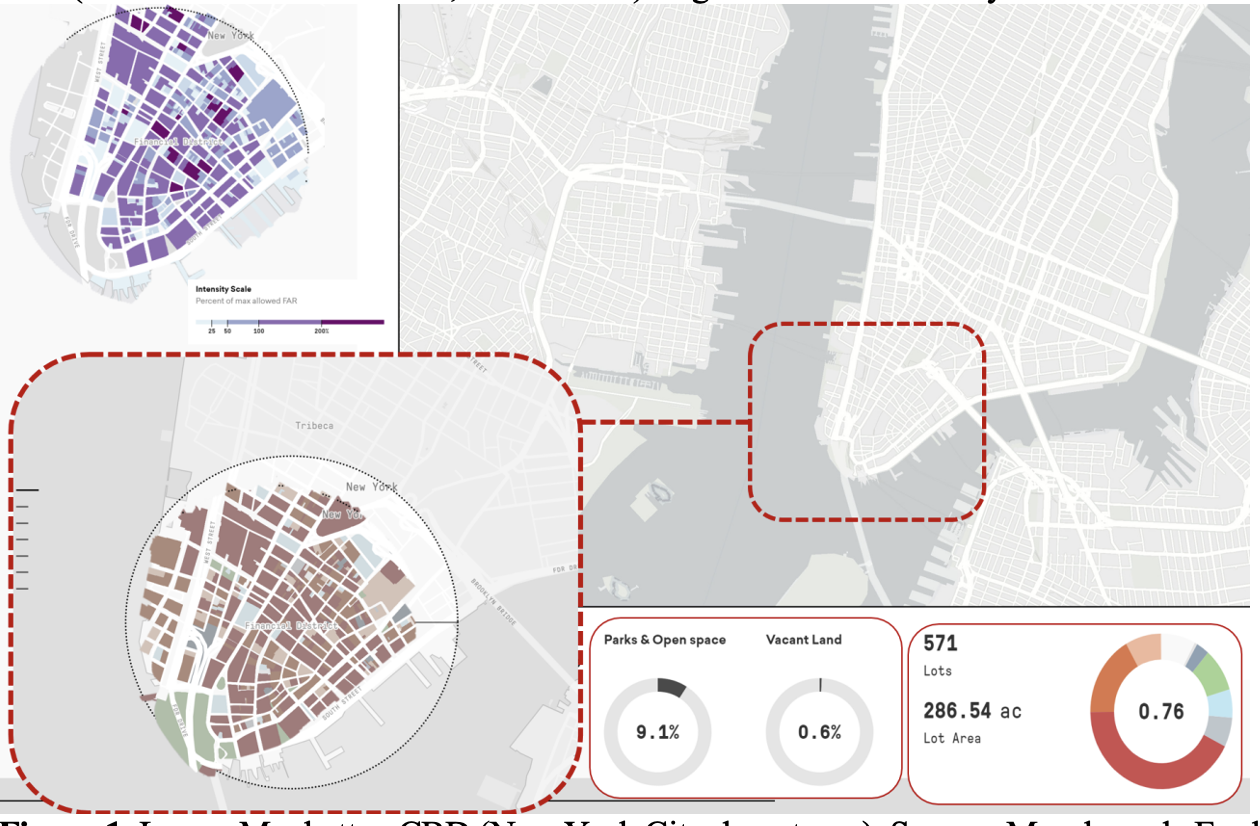
A significant challenge arises in the characterization of urban systems, especially regarding the intricate structures of Central Business Districts (CBDs). Conventional models seem insufficient, failing to comprehend the non-linear, network-oriented structure of the city's economic and social dynamics. This creates a disparity between the city's physical, geographical structure and the unseen processes occurring within it. The fundamental inquiry is thus configurational: how can we systematically examine the inherent spatial logic of the CBD to develop a more efficient and predictive planning model? This paper presents a theoretical and methodological model to explore this inquiry, which focuses on Lower Manhattan as the primary subject of analysis. The aim of the research is to develop an analytical model that fosters a relational comprehension of the city as a system. The methodology combines graph-theoretic mathematical coding with spatial syntax analysis to elucidate the fundamental structure of dynamics in the Central Business District. We evaluate vulnerability as an intrinsic characteristic of network topology, apply Prüfer’s code to determine its distinctive structural signature, and employ various syntactic methods to examine its spatial configuration. Q-analysis, Zipf's law, Markov chains, and fractal analysis elucidate the interconnectedness of shape, function, and temporal change in various dimensions. The findings indicate that the layout of Lower Manhattan possesses a complex, robust, and well-structured network topology. We observed correlations between spatial integration indices and economic activity patterns; that is, the grid is an essential component of the economic functionality. The proposed model is both predictive and quantitative, which activates the comprehension of urban complexity. The systematic relationship elucidates the connection among geographical form, economic function, and susceptibility to potential threats. This framework offers a model for urban planners and designers to enhance connectivity, pinpoint structural deficiencies, and devise solutions that promote sustainable, resilient, and economically viable urbanism.
REFERENCES
Abbas, T. M., and A. Q. Al-Dujaili. “Historical Paths and the Growth of Baghdad Old Center.” Journal of Engineering 19, no. 9 (2013): 1073–93.
Agarwal, J. D., M. Agarwal, A. Agarwal, and Y. Agarwal. “Theory of Land and Efficient Land Markets through Real Estate Exchange.” Finance India 31, no. 2 (2017): 413–42.
Alam, N., M. S. Alam, and S. Tesfamariam. “Buildings’ Seismic Vulnerability Assessment Methods: A Comparative Study.” Natural Hazards 62 (2012): 405–24. https://doi.org/10.1007/s11069-011-0082-4.
Alexander, Christopher. A City Is Not a Tree: 50th Anniversary Edition. Portland, OR: Sustasis Press/Off the Common Books, 2019.
Ali, L. A., and F. A. Mustafa. “Fractal Dimensional Analysis of Building Facades: The Case of Office Buildings in Erbil City.” Fractal and Fractional 8, no. 12 (2024): 746.
Alonso, William. Location and Land Use: Toward a General Theory of Land Rent. Cambridge, MA: Harvard University Press, 1964.
Amiri-Aref, M., S. Shiripour, and D. Ruiz-Hernández. “Exact and Approximate Heuristics for the Rectilinear Weber Location Problem with a Line Barrier.” Computers & Operations Research 132 (2021): 105293.
Badshah, M. T., A. Khan, H. Rahman, S. Ullah, and Z. Ahmad. “The Role of Random Forest and Markov Chain Models in Understanding Metropolitan Urban Growth Trajectory.” Frontiers in Forests and Global Change 7 (2024): 1345047. https://doi.org/10.3389/ffgc.2024.1345047.
Batty, Michael. The New Science of Cities. Cambridge, MA: MIT Press, 2013.
Batty, Michael, and Paul Longley. Fractal Cities: A Geometry of Form and Function. London: Academic Press, 1994.
Bettencourt, L. M. A., J. Lobo, D. Helbing, C. Kühnert, and G. B. West. “Growth, Innovation, Scaling, and the Pace of Life in Cities.” Proceedings of the National Academy of Sciences 104, no. 17 (2007): 7301–6.
Blanchard, Philippe, and Dimitri Volchenkov. Mathematical Analysis of Urban Spatial Networks. Berlin: Springer, 2008.
Boeing, Geoff. “The Morphology and Circuitry of Walkable and Drivable Street Networks.” In Complex Networks and Their Applications VII, edited by Luca Maria Aiello et al., 3–13. Cham: Springer, 2019.
Burke, Meghan. “Chapter 11 - School Location, Urban Structure, and Accessibility.” In Urban Form and Accessibility, edited by Corinne Mulley and John D. Nelson, 173–86. Amsterdam: Elsevier, 2021.
Carlsson, Gunnar, and Mikael Vejdemo-Johansson. Topological Data Analysis with Applications. Cambridge: Cambridge University Press, 2021. https://doi.org/10.1017/9781108975704.
Ceder, Avishai. Public Transit Planning and Operation: Modeling, Practice and Behavior. 2nd ed. Boca Raton, FL: CRC Press, 2016.
Chao, Hsing-Kang Kenneth. “Representation and Idealization: Diagrammatic Models in the Early Studies of the Spatial Structure of Periodic Markets in Rural China.” East Asian Science, Technology and Society: An International Journal 14, no. 2 (2020): 253–77.
Chen, N., and C. H. Wang. “The Complexity of Integrating Land-Use and Transportation Policies to Promote Sustainable Compact Development.” Journal of Urban Affairs (2025): 1–24. Published ahead of print.
Church, Richard L., Zvi Drezner, Frank Plastria, and Arie Tamir. “Reviewing Extensions and Solution Methods of the Planar Weber Single Facility Location Problem.” Computers & Operations Research 173 (2025): 106825.
Coelho, Maria Paula. “Urban Land Use Dynamics and the Hustle and Bustle of Cities: The Case of Lisbon.” In Hustle and Bustle: The Vibrant Cultures of Port Cities, vol. 3, 255. Lisbon, 2024.
Dawes, Michael J., and Michael J. Ostwald. “Precise Locations in Space: An Alternative Approach to Space Syntax Analysis Using Intersection Points.” Architecture Research 3, no. 1 (2013): 1–11.
Delcey, Thomas, and Francesco Sergi. “The Efficient Market Hypothesis and Rational Expectations Macroeconomics: How Did They Meet and Live (Happily) Ever After?” The European Journal of the History of Economic Thought 30, no. 1 (2022): 86–116.
Dijkstra, E. W. “A Note on Two Problems in Connexion with Graphs.” Numerische Mathematik 1 (1959): 269–71.
Fair, E. M. “The Evolution of Urban Rent Theory: Class and Distribution.” Journal of Economic Issues 58, no. 2 (2024): 598–604.
Fleischmann, Martin, Alessandra Feliciotti, Ombretta Romice, and Sergio Porta. “Methodological Foundation of a Numerical Taxonomy of Urban Form.” Environment and Planning B: Urban Analytics and City Science 49, no. 4 (2022): 1283–99. https://doi.org/10.1177/23998083211070502.
Fujita, Masahisa, Nobuaki Hamaguchi, and Yoko Kameyama. Spatial Economics for Building Back Better. Singapore: Springer, 2021.
Fujita, Masahisa, Paul R. Krugman, and Anthony J. Venables. The Spatial Economy: Cities, Regions, and International Trade. Cambridge, MA: MIT Press, 2001.
Gholami, A. A. “Land Use and Transportation Interaction Modelling Frameworks.” In Models for Spatial Consequences of Changes in Commuting Patterns, vol. 4. 2024.
Graham, Lindsay, Wouter Debucquoy, and Isabelle Anguelovski. “The Influence of Urban Development Dynamics on Community Resilience Practice in New York City after Superstorm Sandy: Experiences from the Lower East Side and the Rockaways.” Global Environmental Change 40 (2016): 112–24. https://doi.org/10.1016/j.gloenvcha.2016.07.007.
Grassberger, Peter, and Itamar Procaccia. “Characterization of Strange Attractors.” Physical Review Letters 50, no. 5 (1983): 346–49.
Griffiths, Sam. “The Use of Space Syntax in Historical Research: Current Practice and Future Possibilities.” Paper presented at the Eighth International Space Syntax Symposium, Santiago, Chile, 2012.
Hao, Lin, Shuhan Zhang, Fengqi Zhang, Yubao Ren, Xuan Zhang, and Jie Yan. “Balancing Water Saving, Market Attractiveness, and Pollution Control in Crop Spatial Planting Structure Planning of Arid Regions.” Agricultural Water Management 309 (2025): 109348.
Hart, Peter E., Nils J. Nilsson, and Bertram Raphael. “A Formal Basis for the Heuristic Determination of Minimum Cost Paths.” IEEE Transactions on Systems Science and Cybernetics 4, no. 2 (1968): 100–07.
Heath, Tim, Taner Oc, and Steve Tiesdell. Public Places – Urban Spaces: The Dimensions of Urban Design. 2nd ed. London: Routledge, 2011.
Hewitt, R. J., M. Shadman Roodposhti, and B. A. Bryan. “There’s No Best Model! Addressing Limitations of Land-Use Scenario Modelling through Multi-Model Ensembles.” International Journal of Geographical Information Science 36, no. 12 (2022): 2352–85.
Hillier, Bill. Space Is the Machine: A Configurational Theory of Architecture. Cambridge: Cambridge University Press, 1996.
Hillier, Bill, and Julienne Hanson. The Social Logic of Space. Cambridge: Cambridge University Press, 1984. https://doi.org/10.1017/CBO9780511597237.
Hosseini, S. A., M. Ghazanfari, S. H. Mirjalili, and M. Ghasemi. “Decoding Architectural Design Elements through Shape Grammar.” Bagh-e Nazar 21, no. 4 (2024).
Jäger, Jörg. “Land Rent Theory.” In International Encyclopedia of Human Geography, edited by Audrey Kobayashi, 2nd ed., 93–98. Amsterdam: Elsevier, 2020.
Jenelius, Erik, and Oded Cats. “The Value of New Public Transport Links for Network Robustness and Redundancy.” Transportmetrica A: Transport Science 11, no. 9 (2015): 819–35.
Jiang, Bin, and Xiaobai Yao, eds. Geospatial Analysis and Modelling of Urban Structure and Dynamics. Dordrecht: Springer, 2012.
Kitchin, Rob, and Sung-Yueh Perng, eds. Code and the City. London: Routledge, 2016. https://doi.org/10.4324/9781315645274.
Klopfer, Florian. “The Thermal Performance of Urban Form – An Analysis on Urban Structure Types in Berlin.” Applied Geography 152 (2023): 102890.
Kleiber, Max. “Body Size and Metabolic Rate.” Physiological Reviews 27, no. 4 (1947): 511–41.
Kruskal, Joseph B. “On the Shortest Spanning Subtree of a Graph and the Traveling Salesman Problem.” Proceedings of the American Mathematical Society 7, no. 1 (1956): 48–50.
Lea, Diane, Jennifer Bradshaw, Michael Ashby, and Angus Stevenson, eds. Oxford Learner’s Dictionary of Academic English. Oxford: Oxford University Press, 2014.
Lowry, Ira S. A Model of Metropolis. Memorandum RM-4035-RC. Santa Monica, CA: Rand Corporation, 1964.
Lynch, Kevin. Good City Form. Cambridge, MA: MIT Press, 1984.
Mandelbrot, Benoit B. The Fractal Geometry of Nature. New York: W. H. Freeman, 1982.
Martí, Rafael, and Anna Martínez-Gavara. Discrete Diversity and Dispersion Maximization: A Tutorial on Metaheuristic Optimization. Cham: Springer, 2023.
Mathey, Juliane, J. Hennersdorf, I. Lehmann, and W. Wende. “Qualifying the Urban Structure Type Approach for Urban Green Space Analysis: A Case Study of Dresden, Germany.” Ecological Indicators 125 (2021): 107519.
McDonald, John F. “Mr. Ricardo’s Theory of Land Rent.” Journal of Real Estate Practice and Education 21, no. 1 (2018): 1–15.
McIntosh, Colin, ed. Cambridge Advanced Learner’s Dictionary. 4th ed. Cambridge: Cambridge University Press, 2013.
Muth, Richard F. “The Distribution of Population within Urban Areas.” In Determinants of Investment Behavior, 271–99. New York: National Bureau of Economic Research, 1967.
Nash, John F. “Equilibrium Points in n-Person Games.” Proceedings of the National Academy of Sciences 36, no. 1 (1950): 48–49.
Norris, J. R. Markov Chains. Cambridge: Cambridge University Press, 1997. https://doi.org/10.1017/CBO9780511810633.
O’Regan, Gerard. Mathematics in Computing: An Accessible Guide to Historical, Foundational and Application Contexts. 2nd ed. Cham: Springer, 2020.
Oller, John W., Jr. Coding Information in Natural Languages. Berlin: De Gruyter, 2019. https://doi.org/10.1515/9783110861909.
Pacione, Michael. Urban Geography: A Global Perspective. 3rd ed. London: Routledge, 2009.
Pearl, Judea. Heuristics: Intelligent Search Strategies for Computer Problem Solving. Reading, MA: Addison-Wesley, 1984.
Pinho, Paulo, and Cristina Silva. Mobility Patterns and Urban Structure. London: Routledge, 2016.
Portugali, Juval. Complexity, Cognition and the City. Berlin: Springer, 2011.
Prüfer, Heinz. “Neuer Beweis eines Satzes über Permutationen.” Archiv der Mathematik und Physik 27 (1918): 142–44.
Ribeiro, Fábio L., and Diego Rybski. “Mathematical Models to Explain the Origin of Urban Scaling Laws.” Physics Reports 1012 (2023): 1–39. https://doi.org/10.1016/j.physrep.2023.02.002.
Ricardo, David. The Principles of Political Economy and Taxation. Edited by E. C. K. Gonner. London: G. Bell and Sons, 1891.
Richardson, Douglas, Noel Castree, Michael F. Goodchild, Audrey Kobayashi, Weidong Liu, and Richard A. Marston, eds. International Encyclopedia of Geography: People, the Earth, Environment and Technology. 15 vols. Hoboken, NJ: Wiley, 2017.
Roos, Anders, Jens Eggers, Cecilia Mark-Herbert, and Anders Lindhagen. “Using von Thünen Rings and Service-Dominant Logic in Balancing Forest Ecosystem Services.” Land Use Policy 79 (2018): 622–32.
Rogers, Brian. Perception: A Very Short Introduction. Oxford: Oxford University Press, 2017.
Salingaros, Nikos A. Principles of Urban Structure. Amsterdam: Techne Press, 2005.
Samarin, Maxim, Manish Sharma, and Nicholas N. Nagle. “Geographies and Determinants of Rent Burden: A Regional Economic Analysis of the US Metropolitan Landscape.” Regional Science Policy & Practice 16, no. 7 (2024): 100072.
Schneider-Sliwa, Rita. “Urban Geography.” In International Encyclopedia of the Social & Behavioral Sciences, edited by James D. Wright, 2nd ed., 800–06. Amsterdam: Elsevier, 2015.
Shannon, Claude E. “A Mathematical Theory of Communication.” The Bell System Technical Journal 27, no. 3 (1948): 379–423.
Siegfried, Tom. A Beautiful Math: John Nash, Game Theory, and the Modern Quest for a Code of Nature. Washington, DC: Joseph Henry Press, 2006. https://doi.org/10.17226/11612.
Stiny, George. “Introduction to Shape and Shape Grammars.” Environment and Planning B: Planning and Design 7, no. 3 (1980): 343–51.
Sun, Y., Z. Wang, L. Liu, F. Li, and W. Jiang. “Scenario Construction and Vulnerability Assessment of Natural Hazards-Triggered Power Grid Accidents.” Journal of Safety Science and Resilience 5, no. 4 (2024): 498–511.
Tabak, John. Beyond Geometry: A New Mathematics of Space and Form. New York: Chelsea House, 2011. https://doi.org/10.1002/9781446300357.
Taylor, Peter J., and Michael Hoyler. “Lost in Plain Sight: Revealing Central Flow Process in Christaller’s Original Central Place Systems.” Regional Studies 55, no. 2 (2020): 345–53.
Tchertov, Lev. Signs, Codes, Spaces, and Arts: Papers on General and Spatial Semiotics. Newcastle upon Tyne: Cambridge Scholars Publishing, 2019.
U.S. Federal Transit Administration. Second Avenue Subway in the Borough of Manhattan, New York County: Environmental Impact Statement. 2004.
Webber, Melvin M. Explorations into Urban Structure. Philadelphia: University of Pennsylvania Press, 2016.
Weber, Alfred. Alfred Weber’s Theory of the Location of Industries. Translated by Carl J. Friedrich. Chicago: University of Chicago Press, 1929.
West, Geoffrey B., James H. Brown, and Brian J. Enquist. “A General Model for the Origin of Allometric Scaling Laws in Biology.” Science 276, no. 5309 (1997): 122–26.
Willis, Carol. “A 3-D CBD: How the 1916 Zoning Law Shaped Manhattan’s Central Business Districts.” In Planning and Zoning New York City: Yesterday, Today, and Tomorrow, 3–26. New York: Routledge, 2023. https://doi.org/10.4324/9781003254293-2.
Wilson, Alan G. Being Interdisciplinary: Adventures in Urban Science and Beyond. London: UCL Press, 2022.
Yan, Song Y. Computational Number Theory and Modern Cryptography. Hoboken, NJ: Wiley, 2013. https://doi.org/10.1002/9781118188606.
Zhang, S., J. Xu, Y. Li, and H. Chen. “Applicability Study on a Hybrid Renewable Energy System for Net-Zero Energy House in Shanghai.” Energy Procedia 88 (2016): 768–74. https://doi.org/10.1016/j.egypro.2016.06.108.
Zheng, Yu. Urban Computing. Cambridge, MA: MIT Press, 2019.
Zipf, George K. Human Behavior and the Principle of Least Effort: An Introduction to Human Ecology. Cambridge, MA: Ravenio Books, 2016.
INTERNET
Morphocode Explorer, 2024. Urban data visualization platform. Available at:
https://morphocode.com/explorer
NYC Department of Transportation, 2024. Bi-Annual Pedestrian Counts. Available at:
NYC Storefront Activity, 2024. Storefront Turnover Data. Available at: https://www.nyc.gov/storefrontactivity
Downtown Manhattan Flood Map and Climate Risk Report. Available at: https://floodfactor.com
Manhattan Housing Market Report, 2024. Real Estate Data. Available at: https://www.rockethomes.com
Copyright (c) 2026 tamara mutaz, zainab khalid

This work is licensed under a Creative Commons Attribution-NonCommercial-ShareAlike 4.0 International License.
Authors who publish with this journal agree to the following terms:
- Authors retain copyright and grant the journal right of first publication with the work simultaneously licensed under a Creative Commons Attribution License that allows others to share the work with an acknowledgement of the work's authorship and initial publication in this journal which is under a Attribution-NonCommercial-ShareAlike 4.0 International license (CC BY-NC-SA 4.0).
- Authors are able to enter into separate, additional contractual arrangements for the non-exclusive distribution of the journal's published version of the work (e.g., post it to an institutional repository or publish it in a book), with an acknowledgement of its initial publication in this journal.
- Authors are permitted and encouraged to post their work online (e.g., in institutional repositories or on their website) prior to and during the submission process, as it can lead to productive exchanges, as well as earlier and greater citation of published work (See The Effect of Open Access).